Real-Time Drilling Intelligence.
Sentinel RT is Intellicess’s real-time drilling intelligence engine. At its core are multiple physics-infused Bayesian networks, built and refined over more than ten years and validated on 5,000+ wells. Using standard real-time EDR data and basic daily report data, Sentinel RT filters out bad sensor data before it can mislead anyone, then turns raw signals into beliefs about what is happening downhole, much as an experienced driller interprets the same signals.
Drilling a well means watching 50+ real-time sensor streams at once while managing a crew and making split-second decisions around the clock. No human can do that consistently, and raw time-series data defeats even large language models and general-purpose agentic AI. When a signal is missed, the cost is immediate: a stuck pipe event can run up to $550K, a washout up to $475K, bit damage up to $140K, and that is before counting the invisible lost time that never makes it into an incident report.

What Sentinel RT Delivers
Across two operators and 24 rigs, the annualized cost of these failures ran into the tens of millions: $13.8M in stuck pipe cost, $5.6M in washouts and twist-offs, $4.7M in bit damage, and another $13.7M in invisible lost time from extra bit runs, mis-set weight on bit, lost ROP, and hole cleaning cycles that ran either too long or not long enough. Sentinel RT works like a seasoned expert on every rig: it detects problems before they become costly failures, alerts the crew, advises on corrective action, and looks for opportunities to drill better. One operator alone documented more than $12 million in savings in a single year, a 12x return on its investment.

Why Use a Bayesian Network
Sentinel RT’s Bayesian network reasons under uncertainty much as an experienced driller does, weighing evidence rather than applying rigid yes/no rules. Each dysfunction is assigned a belief, a probability between 0 and 1. Values near 1 mean the system is highly confident the dysfunction is occurring; values near 0 mean it is confident it is not. Bayesian networks are a foundational reasoning engine in probabilistic AI. They combine an explicit, interpretable model structure, a strength shared with symbolic AI, with rigorous reasoning under uncertainty. Unlike most data-driven tools, which need large historical datasets for training, Sentinel RT uses data to validate its models, not to train them. This matters because drilling varies enormously across geological basins, rig types, surface and downhole equipment, and the drilling process itself, a diversity that makes data-trained models hard to generalize. Because Sentinel RT’s models are built on first principles, combining physics with subject matter expertise, they can be expanded, scaled, and extended quickly. When a new rig, well, or situation is encountered, there is no retraining and no need for a large dataset.
Why are Bayesian networks the right approach for real-time drilling data?
1. They handle uncertainty and risk
Drilling, like medicine, finance, and military strategy, is a field where facts are rarely 100% certain. Bayesian networks quantify that uncertainty as probabilities and update them continuously as new information arrives.
2. They work when data is scarce but expert knowledge is deep
Deep learning needs millions of examples to learn a concept. Bayesian networks can be built directly from physics and the knowledge of experienced drillers and engineers, or from a small amount of data combined with expert rules.
3. They diagnose root causes
Bayesian networks are the standard tool for root cause analysis. When something goes wrong in a complex system, a Bayesian network can weigh a cascade of inputs and identify the most likely underlying cause.
4. They reason about cause and effect
Most machine learning models find correlations, not causes. Bayesian networks model causality directly: did action A cause outcome B? That distinction is essential for real situational awareness, and it is what makes autonomous drilling possible.
Case 01: Abnormal Pressure Loss Detection
Washouts and pump failures share nearly identical pressure signatures, and by the time a pressure drop is unmistakable to the eye, a downhole washout can be minutes from a full twist-off. Telling a real washout apart from ordinary pump degradation, and catching it early enough to matter, is hard to do on noisy field data. Intermittent washouts make it harder still: an initial crack at a connection can open and close under load, so the pressure loss comes and goes before it becomes sustained.

Sentinel RT combines several independent signals into a single Abnormal Pressure Loss Belief: a network-based washout and pump failure belief that tracks the flow-in and flow-out hydraulic coefficients, an SPP washout belief that scans a rolling 20-minute window of standpipe pressure, torque, and WOB to catch rapid drops within a stand, and a statistical washout belief that compares real-time standpipe pressure against a pump pressure model built from the well’s own drilling history. The combined belief recognizes the distinct signatures of drill pipe body washouts (a steady bleed-off over several stands), connection washouts (intermittent drops that grow more frequent as the joint worsens), mud motor connection failures (fast-developing), and BHA tool failures such as a leaking seal.
Each alert can be followed as it develops. A belief between 0.50 and 0.70 calls for close monitoring over the next 6 to 12 hours. A belief above 0.70 calls for an immediate check of the surface system and pumps, followed by a slow pump rate test compared against the statistical model to determine whether it is time to trip out and inspect for a washout or downhole tool failure. That standard decision path is what turns an early warning into a prevented twist-off and an avoided fishing job.
Case 02: ROP Optimization
Drillers push weight and rotary speed to chase rate of penetration, but the dysfunctions that quietly erode ROP, such as stick slip, whirl, and bit balling, often go unnoticed until footage has been lost or the bit itself is damaged.
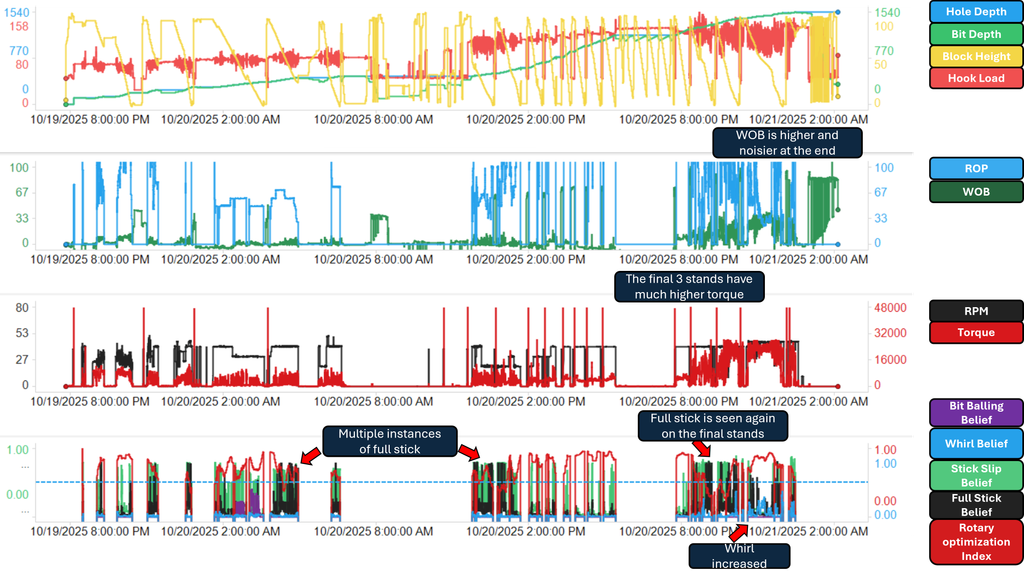
Sentinel RT’s Bayesian networks continuously screen for the five dysfunctions that most commonly rob ROP. Each runs as its own belief, so the driller sees the specific problem rather than a generic warning: stick slip, both on and off bottom; full stick, identified by the sawtooth torque signature of a motor stalling and releasing; bit balling, flagged by falling bit aggressiveness and ROP under constant WOB and most common when using water-based mud; bit bounce, seen in erratic depth of cut and WOB variation; and whirl, where depth of cut falls as surface MSE climbs
That detection feeds directly into ROP optimization. Offset well data is first analyzed to build a depth-based ROP roadmap, which can be padded with a target improvement (10% is a common starting point) and then handed to Sentinel RT. As drilling proceeds, Sentinel RT monitors for dysfunction and guides the driller toward the recommended ROP through WOB and RPM corrections corresponding to the specific dysfunction at play, taking into consideration critical RPMs to avoid.
With Intellicess’s sister product, Liken, roadmaps can now be generated through an automated scientific workflow that combines UCS data with machine learning to find the best parameters from offset analysis, using a fitted founder curve. Engineers review the result and push a button to upload it to the EDR for real-time optimization. The roadmap can be adjusted mid-well as actual conditions diverge from the offset data it was built on.
Case 03: Hole Cleaning Effort Monitoring
Hole cleaning competes directly with ROP for the same rig time. Circulate and rotate longer than needed to clear cuttings and drilling time is lost; push ROP without enough flow and rotation and cuttings accumulate, pack off the annulus, and can stick the pipe. Getting that balance right by feel, on every stand and across a whole fleet, is difficult.
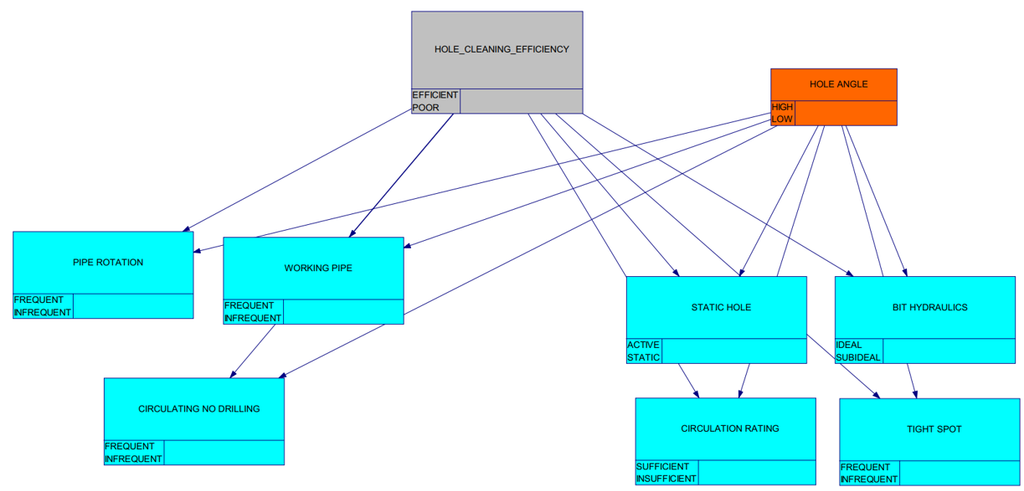
The Hole Cleaning Effort Belief weighs several factors, with the most recent activity counting most heavily: bit hydraulics against a modeled cuttings transport threshold, circulation rate against that same threshold, how long and how recently the well has sat static, how often tight spots have appeared in the overpull and underpull history, time spent circulating without drilling, pipe rotation and working-pipe activity (reaming, back-reaming, and circulating with block movement), and wellbore angle. The result is a single trend an engineer can read at a glance rather than eight separate channels to reconcile by hand. In the field, this approach has proven more accurate than dynamic hole cleaning models, which depend on too many unknowns (cuttings size, shape and density, downhole mud rheology downhole, etc.) to reach reliable accuracy in real time.
That single trend lets an engineer / driller weigh rising hole cleaning risk directly against the ROP currently being achieved and decide whether to slow down and circulate proactively or keep drilling, instead of treating the two as separate, uncoordinated decisions made by different people at different times.
Case 04: Directional Drilling Dysfunction Advisory
During slide drilling, a directional driller is managing toolface, build and turn rates, and the risk of buckling or losing weight to friction, sometimes from a remote operations center with limited feel for what is actually happening downhole. Waiting for build and turn rates to visibly drift from plan means the correction comes only after control has already been lost.
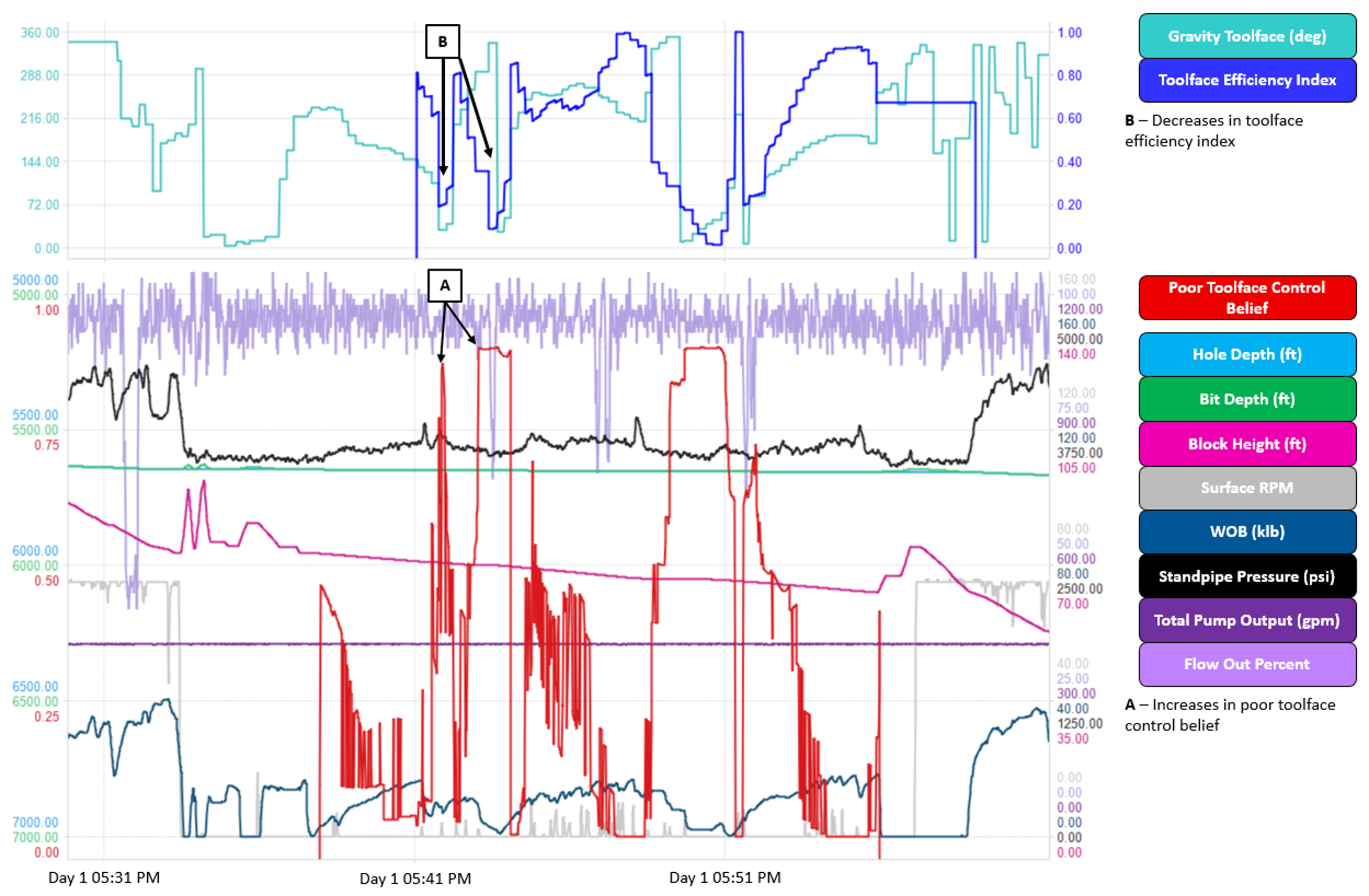
A dedicated Bayesian network monitors the downhole MSE trend, wellbore friction, toolface efficiency (how consistent the toolface angle stays through a slide), the differential pressure trend, and the margin to the buckling limit, and flags four slide-specific dysfunctions in real time: buckling, high friction, poor toolface control, and motor stall. Buckling risk is quantified by comparing the actual WOB against the critical helical buckling load calculated from pipe geometry, material, and wellbore curvature.
A Slide Optimal Drilling Index, scored 0 to 1, gives a single read on whether a dysfunction is present, and an advisory points to the specific corrective action for each dysfunction: increase flow rate and reduce differential pressure for motor stall, reduce differential pressure for buckling, consider a pipe rocking regime for high friction. The advisory is configurable, so an operator’s own limits, such as a maximum differential pressure, always take precedence over the default suggestion.
Case 05: Auto-Zero WOB
On most land rigs, weight on bit is never measured at the bit. It is calculated at surface by subtracting an off-bottom hook load reference the driller sets manually, and a study of 40 wells found WOB was either zeroed incorrectly or not zeroed at all in 86% of all stands, with drillers performing a string weight calibration in only 31% of stands on average (Neufeldt et al., 2020).

Sentinel RT automates that reference with two complementary methods. Static zeroing captures the reference during circulation and rotation with no axial pipe movement, the condition closest to conventional manual zeroing. Dynamic zeroing captures it while the pipe is moving under rotation and circulation, both before and after a connection, which more closely represents the string’s actual mechanical state while drilling. Both methods update automatically without driller input and fall back to the last valid reference whenever a clean reading is not available. A further correction accounts for the top drive service loop: as the stand drills down, part of the loop’s weight transfers to the derrick, and the reference is adjusted to compensate.
Validated across 12 runs on 7 wells spanning vertical, curve, and lateral sections, both methods proved more accurate and less variable than manual zeroing. In many cases the driller’s own WOB tracked closer to the static estimate than to the dynamic one, which means actual WOB had been overestimated because axial drag was going unaccounted for, an effect most pronounced in the higher-angle sections where drag matters most.
Case 06: Rig State & Drilling Mode Detection
Every KPI, from connection time to slide efficiency, depends on knowing exactly what the rig was doing at each moment, and rig-state logic breaks down precisely at the ambiguous, transitional moments. Is this slide drilling or rotary drilling at low speed? Is that RPM oscillation pipe rocking or something else? Did that pressure blip come from a downlink rather than a real event?

Sentinel RT’s rig state engine classifies rig activity continuously: rotary and slide drilling, tripping in or out with or without circulation, connections, reaming, back-reaming, conditioning mud, breaking circulation, pressure testing, static, and out of hole. It does this by combining instantaneous features (current values such as ROP and hookload) with trend features (how WOB, torque, and similar channels are changing over time). Because every rig and crew is classified on the same basis, fleet-wide KPIs such as weight-to-weight, slip-to-slip, weight-to-slip, and slip-to-weight times become directly comparable.
Slide drilling gets special handling. Sentinel RT first rules out rotary drilling with soft speed or soft torque, which can look similar, then checks for RPM oscillation and, if that is inconclusive, torque oscillation to confirm true pipe rocking. The same pattern recognition extends to downlinks: Sentinel RT recognizes the deliberate flow, pressure, or rotation modulation used to communicate with downhole tools, so that other beliefs, including the rolling pressure window in the abnormal pressure loss belief, reset correctly instead of mistaking a downlink for a real abnormal pressure loss event.
Case 07: Mud Volume, Loss/Gain & Kick Indicator Detection
Pit volume swings for many ordinary reasons: connections, mud additions, surface transfers. Only some of those swings mean fluid is actually being lost to or gained from the formation. Distinguishing a real kick or loss event from routine pit activity, especially during a connection, is easy to get wrong under pressure.

Sentinel RT filters total mud volume against recognized connection flowback and pump-activity flowback patterns to isolate the trend that actually matters, then compares the real-time flow-out trend and a modeled gain or loss rate against pump pressure behavior to flag abnormal gains and losses. Connection influxes are evaluated separately, and only during connections themselves: a gain is flagged as abnormal only when it is meaningfully larger than that well’s own recent connection gain history, rather than against a fixed, one-size-fits-all threshold.
An NLP layer reads the driller memos typed directly into the EDR, sorts them by topic, and feeds that context into the mud addition and abnormal loss/gain beliefs alongside the volume data itself. Combining what the crew has already documented with what the sensors show delivers faster detection, better accuracy, and fewer false alarms than either source could achieve alone.
Case 08: Stuck Pipe Root Cause Prediction & Early Warning
Stuck pipe is estimated to account for more than a quarter of drilling non-productive time industry-wide. The standard root-cause worksheet is filled out by hand by the rig crew, usually after the fact, which makes it slow and error-prone at exactly the moment when fast, correct action matters most.

Sentinel RT calculates reference hook load and torque directly from real-time rig data and continuously tracks how far actual values deviate from those references to quantify stuck pipe risk. Once that risk crosses a threshold, a Bayesian network evaluates the frequency and severity of pack-offs, tight spots, and elevated breakover torque and drag over the preceding hours or days, together with the pattern of restrictions to axial movement, rotation, and circulation before and after the event, to determine whether the root cause is pack-off and bridging, differential sticking, or wellbore geometry.
Validated on datasets from hundreds of stuck pipe incidents across onshore and offshore operations, the system identified the risk and correct root cause in over 98% of cases and is deployed on 50+ rigs today. In several cases it alerted more than 12 hours ahead of the stuck pipe event, and in one case it flagged the exact interval that where the pipe will get stuck upon re-entry. It works during liner and casing runs as well as BHA runs, and process charts translate each root cause diagnosis into a recommended recovery response for the rig crew.
Why Sentinel RT?
Interpretable. Proven. Deployable anywhere. Available to anyone
Interpretable AI, Not a Black Box. Bayesian networks show which specific features drove a belief, not just a probability score, building the trust and adoption a black-box model can’t earn.
Extensive Validation. Built on 5,000+ wells and 10+ years of real-world drilling data.
Runs Anywhere. Requires only 4 cores, 2 GB of RAM, written in Java: deploys as a backend engine on the edge, in the cloud, or inside an existing SCADA system, no infrastructure replacement required.
Available for Anyone in the Well Construction Business. Licensed directly by operators, white-labeled and embedded by service providers and rig contractors.
Proven at Scale. Live on 50+ active rigs across 7 countries, with one operator alone documenting over $12 million in savings in a single year, a 12x return.
The Situational Awareness Layer for Autonomous Drilling. As drilling automation grows, Sentinel RT is the perception and trust layer underneath it.
How Sentinel RT Works
A lightweight engine that fits into whatever infrastructure already exists on the rig or in the cloud.
Lightweight Footprint. Runs on just 4 cores and 2 GB of RAM, written in Java, with no specialized hardware required.
Deploy Anywhere. On the edge at the rig, in the cloud, or inside an existing SCADA or EDR system, deployed without replacing existing infrastructure.
Physics-Infused Bayesian Networks. Combines physics-based models with probabilistic reasoning, validated across 5,000+ wells over more than 10 years, filtering bad sensor data before it can alter any belief.
Available However You Buy It. As a licensed product for operators, an embedded backend for service providers, or a monitoring layer for rig contractors.
- 4 core / 2 GB footprint
- Any cloud, edge, or SCADA system
- Physics-infused Bayesian AI
- 5,000+ wells of validation
Ready to Add Situational Awareness to Your Rigs?
Sentinel RT is available however you do business with us.
License Directly (Operators). Deploy Sentinel RT annually across your fleet for real-time visibility, historical well analysis, and dataset management, on your own cloud infrastructure.
Partner With Us (Service Providers). Embed Sentinel RT as a backend engine inside your own platform, to differentiate your service and prove value with real-time data.
License for Your Fleet (Rig Contractors). Run Sentinel RT to monitor driller performance, reduce equipment wear, and build toward autonomous drilling readiness.
Start With a Pilot
A 12-week pilot, validated on your own well data, with a target of 90%+ detection accuracy and zero disruption to ongoing operations.
Let’s Build Your Situational Awareness Layer
| 01 Discovery Call Understand your fleet, data environment, and priority use cases. | 02 Pilot on Your Data 12 weeks, validated live against your own wells or on historical datasets. |
| 03 Fleet Rollout Plan A deployment roadmap matched to how you license: operator, service provider, or rig contractor. | 04 Go Live Sentinel RT in production, growing with your fleet from day one. |